
Civil Protection Emergency Instructions
General Instructions by GSCP
GETTING PREPARED
If you are indoors
- Fasten shelves and bookcases to the walls. Remove from the doors tall furniture that could be overturned and block the exit.
- Screw well fuel and water tanks and heaters to the walls.
- Place heavy objects on lower shelves.
- Remove heavy objects from above beds and sofas.
- Fix well all lights and ceiling fans.
- Locate safe spots in each room of the house:
– under sturdy desks or tables,
– away from glass surfaces and bookcases,
– away from exterior walls. - Check the correct function of the electric and gas network.
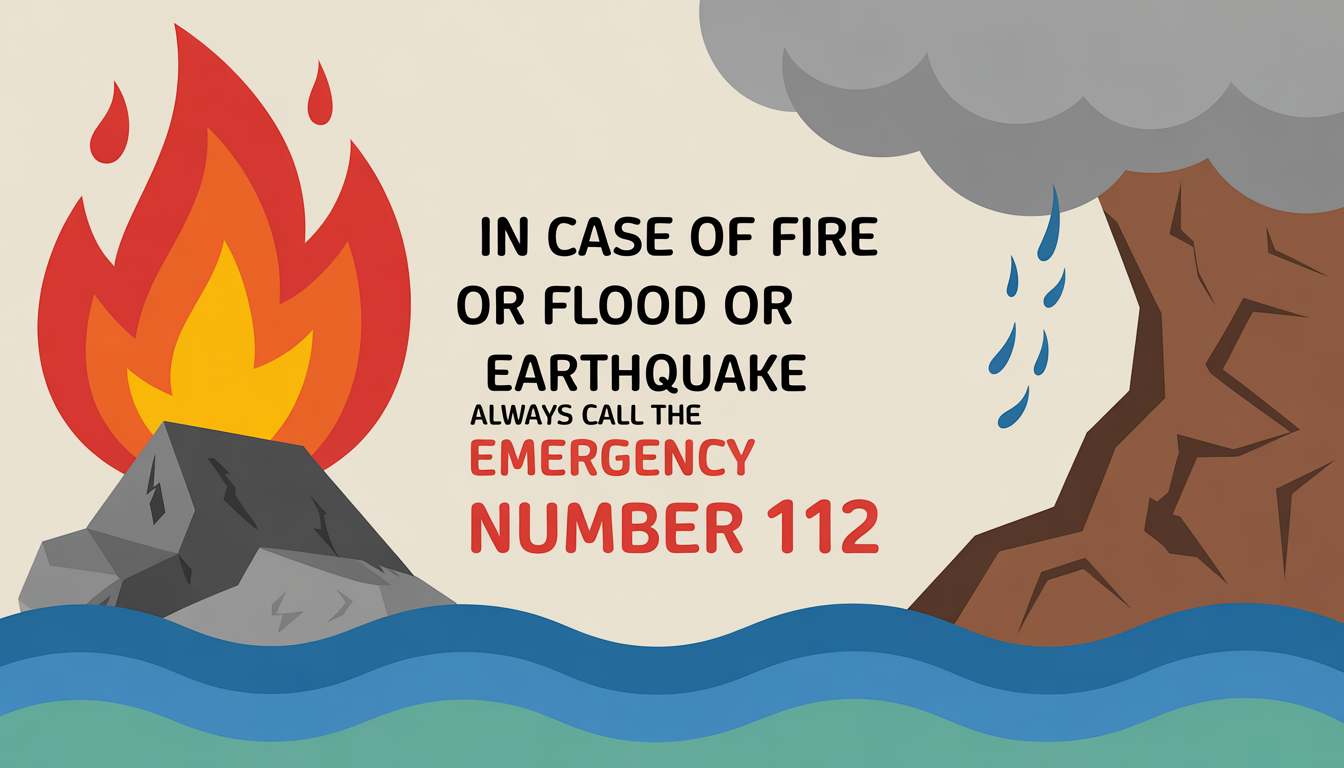
- Inform family members how to turn off electricity, water, gas and on the emergency numbers (112, 199, 166, 100, etc).
- Be equipped with a portable radio with batteries, a torch and a first aid kit.
If you are outdoors
- Fasten shelves and bookcases to the walls. Remove from the doors tall furniture that could be overturned and block the exit.
- Screw well fuel and water tanks and heaters to the walls.
- Place heavy objects on lower shelves.
- Remove heavy objects from above beds and sofas.
- Fix well all lights and ceiling fans.
- Locate safe spots in each room of the house:
– under sturdy desks or tables,
– away from glass surfaces and bookcases,
– away from exterior walls. - Check the correct function of the electric and gas network.
- Inform family members how to turn off electricity, water, gas and on the emergency numbers (112, 199, 166, 100, etc).
- Be equipped with a portable radio with batteries, a torch and a first aid kit.
If you are outdoors
- After the earthquake, agree to meet outdoors at a specific place that is safe and away from:
- – buildings and trees,
– electric and telephone cables.
DURING THE EARTHQUAKE
If you are indoors
- Stay calm.
- Take cover under sturdy furniture (table, desk), kneel and hold its leg with your hands.
- If there is no sturdy furniture around, kneel in the middle of the room, lower your height as much as possible and protect your head and nape with your hands. Move away from large glass surfaces (windows, glass dividers), furniture or objects that could injure you.
- Do not attempt to go out of the house.
- Do not go out on the balcony.
If you are in a tall building
- Move away from glass and exterior walls.
If you are in a recreation place, store or mall
- Stay calm.
- Stay indoors until the earthquake stops.
- Stay away from the panicked crowd moving disorderly toward the exits because of risk of being trampled.
If you are outdoors
- Move away from buildings, electric or telephone cables.
- Cover your head with a briefcase or a purse available.
If you are in a moving vehicle
- Drive to an open space and stop the car carefully so as not to obstruct traffic.
- Avoid tunnels, bridges or pedestrian overpasses.
AFTER THE EARTHQUAKE
If you are inside
- Be prepared for aftershocks.
- Check if you or anyone around you is injured.
- Do not move seriously injured persons.
- Evacuate the building using the stairs (do not use the elevator), after switching off the electricity, gas and water.
- Go towards an open and safe space.
- Follow the instructions of the authorities and do not pay attention to rumors.
- Do not drive unless there is an emergency, so as not to block the work of the rescuers.
- Use your land line or mobile telephone only in emergency to avoid network overload.
- Avoid entering your home if you notice damages, gas leakage or any cables destroyed.
IN CASE OF A TSUNAMI
If you are close to a seaside with low altitude
- Not all earthquakes cause a tsunami. However, when you feel an earthquake, stay alert.
- Observe if there is a significant rise or fall of the water level. This phenomenon is a physical warning for an oncoming tsunami.
- After a strong earthquake leave the seashore and go towards mainland areas of higher altitude. A relatively small-sized tsunami at parts of the coastline could be transformed into an extremely dangerous one in a distance of several kilometers.
- Stay away from seaside areas until you are informed by the competent authorities that the danger is over. A tsunami is not a single wave but a series of waves with different time of arrival at the seashore.
- Do not approach the shore in order to watch a tsunami coming. When you see the tsunami coming, it will probably be too late to avoid it.
DURING THE STORM
If indoors
- Secure all objects that may be carried away by the wind or the heavy rain and cause damage or injuries.
- Secure all suspended signs and billboards.
- Secure doors and windows.
- Do not hold electric equipment or the telephone as thunder may pass through the wires. TV sets should be unplugged from antenna and power supply.
- Avoid touching water pipes (kitchen, bathroom) as they are good electricity conductors.
If outdoors
- Seek refuge in a building or a car, otherwise sit on the ground without lying down.
- If you are in the woods, protect yourself under the dense branches of low trees.
- Never stand under a tall tree in an open space.
- If you are in low land, be careful as a flood may occur.
- Don’t stand close to transmission pylons, tall trees, fences, telephone cables and electric lines.
- Avoid being close to metal objects (such as cars, bicycles, camping equipment, etc).
- Stay away from rivers, lakes or other water bodies.
- If you are in the sea, get out quickly.
- If you are isolated on a plane area and feel your hair stand up (a fact that indicates the imminent occurrence of lightning), assume duck position, burry your head between legs (to minimize the surface of your body and the contact with ground) and throw away any metal objects you carry.
In a vehicle
- Stop the car by the roadside away from trees that may fall on the car.
- Stay in the car and turn on the emergency lights until the storm stops.
- Close the windows and do not touch metal objects in the car.
- Avoid flooded roads.
DURING HAIL
- Protect yourself immediately. Do not leave the safe place unless you make sure that the storm has stopped. Hail can also be very dangerous for animals
GETTING PREPARED
If you are in the countryside
- Don’t burn litter or dry vegetation and small branches (twigs) during the summer.
- Don’t use open-air barbecues in forests or places close to dry vegetation during the summer.
- Avoid open-air activities that may cause fire (i.e. torch weld, wheel or other instruments that create sparks).
- Never throw lit cigarettes in open-air places.
- Don’t leave rubbish in the forest. There is danger of ignition.
- Respect the signs prohibiting access in periods of high risk.
If your home lies inside or near a forest or a forest area
- Create a fire break around your home by clearing dry leaves and vegetation, pine-needles, branches etc at least within a 10 meter radius of your house.
- Prune the trees up to the height of 3 meters, according to their age and condition.
- Remove all dry branches from the trees and the bushes.
- Prune the trees within a 5 meter radius from your home so that their branches don’t lean on the walls, on the roof or the balconies.
- Space out around the building the woody vegetation so that the branches of one tree are at least 3 meters apart from another. For greater protection, remove the woody and bushy vegetation around the building at a distance of at least 10 meters, provided that the clearing of natural vegetation for the necessary protection of buildings is not contrary to the forest legislation provisions.
- Don’t install plastic drain spouts or pipes to the walls of the building.
- Protect the windows and the glass doors by installing shutters from non-flammable materials.
- Cover the chimneys and the ventilation pipes with non-flammable material so that the sparks will not penetrate the interior of the building.
- Don’t store flammable objects close to the house.
- Keep the fire-wood in closed and protected places.
- Don’t build uncovered fuel tanks close to the house.
- Be equipped with the appropriate fire-extinguishers and take care of their maintenance.
- Be equipped with a water hose with length proportional to the area you want to protect.
- Be equipped with a water tank, a simple non-electric powered pump and a water hose.
If you notice fire
- Call IMMEDIATELY the Fire Service call center (199) and give clear information about:
- the location and the exact point where you are,
- the location, the exact point and the direction of fire,
- the kind of vegetation that is burning.
GETTING PREPARED
If fire is approaching your home
- Stay calm.
- Remove all the flammable materials from around the building to closed and protected places.
- Close all the passages (chimneys, windows, doors etc) to prevent sparks entering the building.
- Shut off all the gas and liquid-fuel supplies inside and outside the building.
- Close the awnings on the balconies and the windows.
- Open the gate of the garden to facilitate the fire fighting vehicle access.
- Put a ladder outside the building so that someone is able to climb immediately on the roof. The ladder should be placed at the opposite side of the fire direction.
- Connect the water hoses with the taps outside the building and spread them so that the perimeter of the building is covered.
- If visibility is reduced, switch on the interior and exterior lights of the building in order to be more visible through smoke.
If fire has reached your home
- Do not abandon the building unless your escape is completely secured.
- Do not take shelter in a car. The possibility of survival in a building constructed by non flammable materials is greater than that inside a vehicle close to smoke and fire.
If you stay indoors:
- Close firmly all the doors and windows.
– Block up all the cracks with wet clothes, in order to prevent smoke penetration.
– Remove the curtains from the windows.
– Move any furniture into the center of the residence away from windows and exterior doors.
– Close all interior doors to slow down the fire spreading in the building.
– Fill up the bathtub, wash-basins and buckets so that you have spare water.
– Gather all together in one room.
– Keep a torch and spare batteries at hand in case of electric power failure. - If your home is made of wood, seek shelter in a fire-resistant building.
- If organised relocation is ordered, strictly follow the instructions and the routes suggested by the Authorities.
- Get out of the house and at once put out the remaining hot spots.
- Inspect for at least 48 hours, at regular intervals, the perimeter and the exterior of the building for possible re-ignitions.